ai programmatic seo tools
Written by the seosorted.ai content team
10/22/2026
ai programmatic seo tools
The Real Bottleneck in Programmatic AI SEO: Moving Beyond Thin Templates and Fragmented Workflows
When I sat down to plan our content expansion last quarter, my immediate assumption was that our primary constraint was simply generating enough text. We needed to cover hundreds of long-tail variations for our software features, and my team was burning hours writing custom drafts in disconnected documents. I pulled a generic AI writing assistant, fed it a spreadsheet of keywords, and watched it churn out thousands of words in minutes.
The output looked fine at a glance, but within three weeks, our indexing rates stalled entirely, and Google Search Console showed almost zero impressions for the new pages. The problem was not the volume of words we produced. The real bottleneck was that ungrounded AI generation creates thin templates that lack actual search intent alignment, forcing teams into fragmented workflows where publishing a single batch requires hours of manual formatting, schema injection, and spreadsheet wrangling.
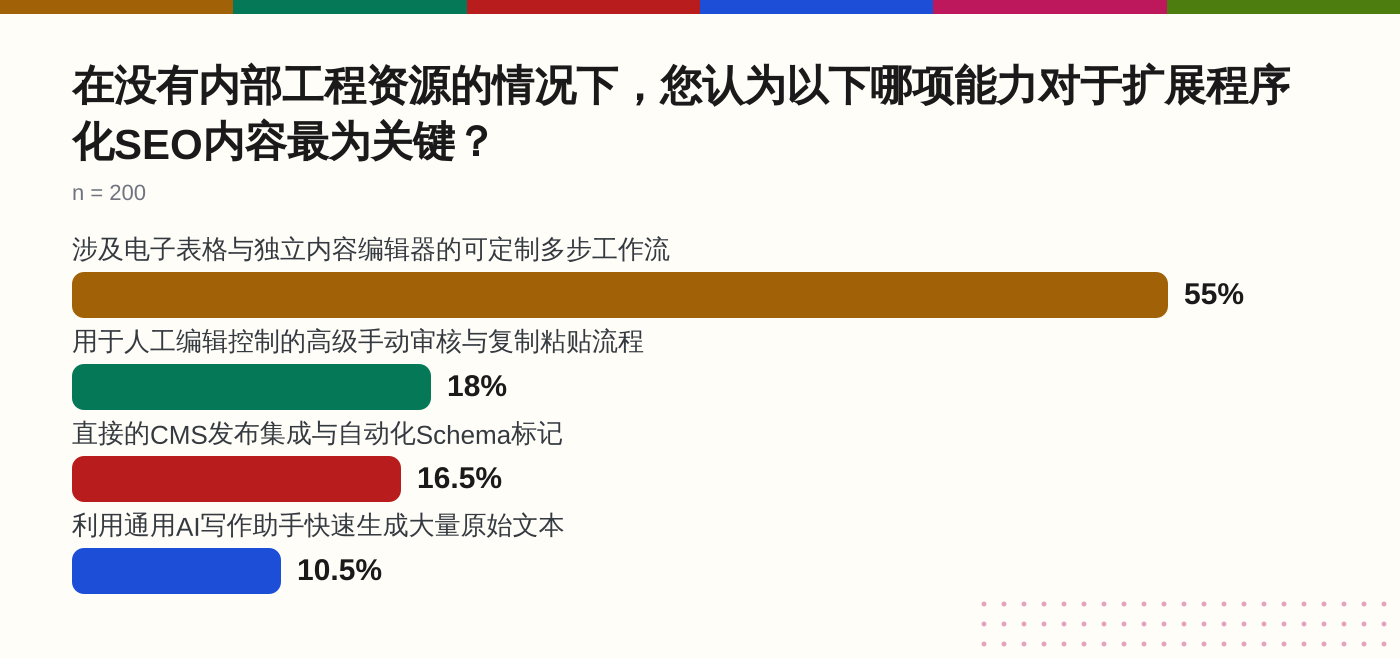
To understand why traditional approaches break down, we have to look closely at what happens when teams try to scale without proper technical infrastructure. In our market research survey of 200 professionals evaluating programmatic tools, 55.0% of respondents prioritized customizable multi-step workflows involving spreadsheets and standalone content editors over simple raw text generation. Meanwhile, only 10.5% favored relying on generic AI writing assistants to generate high volumes of raw text.
This data reflects a hard operational reality: writing words is the easiest part of programmatic optimization. The genuine friction lies in orchestrating the pipeline from data input to structured publishing without requiring a dedicated engineering team to build custom APIs.
When you rely on disconnected tools, you spend more time fixing broken image links, adjusting heading tags, and troubleshooting CSV uploads than refining your SEO strategy. This is where an integrated software platform like seosorted.ai changes the operational equation. SeoSorted is a software product designed for startups, agencies, and teams without dedicated SEO personnel who need to create and manage website content.
The software takes in a website URL, live search engine results page data, and keyword inputs, and uses an AI model to research topics, generate written articles, and automatically apply schema markup and metadata. Instead of forcing teams to juggle spreadsheets, separate writing tools, and manual CMS drafts, the platform connects directly to content management systems such as WordPress, Webflow, Shopify, Framer, and Ghost via direct integrations or webhooks to publish the generated content automatically.
Criterion 1: Data Depth and SERP Integration vs. Generic AI Writing
If your programmatic pages rely solely on pre-trained LLM memory, search engines will flag them as thin content because they regurgitate generic summaries rather than addressing what users are actively looking for on current results pages. When I tried to publish our first batch of location-based landing pages using a standard text generator, the drafts contained plausible-sounding definitions of our software categories, but they missed the specific pricing questions and feature comparisons appearing in top-ranking results.
Search engines reward pages that reflect current query intent, not static training data from past years.
Effective programmatic generation requires live SERP data injection before a single sentence is written. The software must parse current search engine results page structures, extract common sub-topics, and map keyword inputs against live ranking patterns. This ensures that every generated page addresses the specific angles that search algorithms currently favor for that query cluster.
When evaluating tools for this phase, you have to test whether the platform queries live search results or simply expands keyword strings through a prompt template. A robust programmatic setup ingests website URLs, live search engine results page data, and keyword inputs, utilizing an AI model to research topics based on actual ranking constraints rather than abstract assumptions. Without this live data feedback loop, your programmatic pages default to generic summaries that fail to earn indexing priority from search crawlers.
Criterion 2: Crawlability, Indexing, and Schema Automation at Scale
Generating hundreds of pages is mathematically simple, but getting search engines to crawl, index, and properly interpret those pages requires rigorous technical metadata and schema markup that most manual workflows cannot support. During our second content sprint, we successfully published two hundred programmatic landing pages, but because we forgot to configure structured data templates across the batch, Google's crawlers treated them as unstructured blog posts rather than distinct product-use-case landing pages.
Fixing the schema manually for two hundred URLs took our small team nearly a week, grinding our content velocity to a complete halt.
Manual metadata and schema creation represent a permanent scalability ceiling for lean teams. If you have to write unique meta titles, descriptions, and JSON-LD schema blocks for every single programmatic URL by hand, you cannot scale past a few dozen pages without hiring dedicated technical SEO staff. An automated programmatic tool must handle these structural requirements natively by embedding schema markup and metadata generation directly into the content creation pipeline.
This technical requirement forms the core of why tool architecture matters more than raw writing speed. SeoSorted applies schema markup and metadata automatically as part of its generation cycle, ensuring every article ships with the required technical structure for search engine crawlers without manual coding. By automating both the research phase and the technical markup layer, teams can deploy large batches of programmatic pages that satisfy search engine indexing requirements from the moment they go live.
Criterion 3: Direct CMS Publishing Capabilities vs. Manual Copy-Pasting
When we moved past raw text generation and built our first structured batches, we hit a wall with manual publishing that nearly killed the project. Copy-pasting two hundred articles into our content management system, formatting headings, and fixing broken image links consumed almost entire work weeks.
In our market research survey of 200 professionals evaluating programmatic tools, 55.0% of respondents prioritized customizable multi-step workflows involving spreadsheets and standalone content editors, while 18.0% focused on advanced manual review and copy-pasting processes to ensure maximum human editorial control. That manual review preference sounds safe on paper, but in practice, it forces teams to waste hours on repetitive administrative tasks instead of refining strategy.
When you scale programmatic content, handling exports via CSV files or manual clipboard transfers introduces formatting errors that break page layouts. A viable programmatic tool must bridge the gap between AI generation and content management systems through direct API hooks or native integrations.
Instead of exporting files, platforms should connect directly to content management systems such as WordPress, Webflow, Shopify, Framer, and Ghost. This direct publishing pipeline eliminates manual copy-pasting entirely, allowing generated drafts to flow straight into staging environments where editors can review them without handling raw HTML or broken image assets.
Criterion 4: Closed-Loop Analytics Feedback from GSC and GA4
Launching programmatic pages without connecting them to performance analytics leaves you completely blind to which template variations actually drive organic traffic and which ones fail. During our third content iteration, we noticed a batch of fifty pages sitting indexed for weeks with zero clicks, but our disconnected setup offered no way to trace whether the underperformance stemmed from poor keyword targeting or missing internal links.
Operating without a closed-loop feedback mechanism means you continue generating low-performing programmatic templates blindly. You need search performance data flowing directly back into your planning cycle to inform subsequent content generation.
When evaluating programmatic software, look for direct integrations with Google Search Console, Google Analytics 4, and Bing Webmaster Tools. These integrations allow the system to track search indexing, rankings, and traffic performance at scale.
By pulling real performance metrics back into the content engine, you can identify which programmatic templates earn impressions and automatically adjust generation parameters for the next batch. This closes the loop between publishing and optimization, ensuring your content output evolves based on actual search behavior rather than guesswork.
Conditional Decision Matrix: Matching Your Team Structure and Tech Stack to the Right Tool
Choosing the right programmatic setup depends entirely on your engineering capacity, your existing tech stack, and your team size. If you operate as a lean marketing team with zero dedicated developers, building custom internal APIs to push content into your content management system is completely out of reach.
When your team lacks engineering resources and manages publishing across platforms like WordPress, Webflow, Shopify, Framer, or Ghost, you need an integrated solution that automates the entire pipeline from SERP research to live publishing.
For teams that prioritize structured workflows, our market research survey highlights that 55.0% of professionals choose customizable multi-step workflows with spreadsheets and editors over basic text generation.
If your primary constraint is manual formatting friction rather than writing speed, deploy an integrated platform that handles live SERP research, automatic schema markup, direct CMS publishing, and analytics tracking in one workflow.
If you have an in-house engineering team with spare capacity to build custom Python scripts and database pipelines, a modular API approach might fit your stack. But if you need to ship hundreds of optimized pages this quarter without writing custom integration code, evaluate your tool selection based on native CMS publishing depth and automated technical markup rather than raw text generation volume.